
Despite the autumn rain, we set off from Kyiv for a demining site about 100 kilometers north of the capital.
Here, amid agricultural fields broken up by strips of pine forest, lies the village in Ivankivska hromada, Vyshhorod district in Kyivska oblast. Like thousands of Ukrainian villages, it has felt the devastating effects of Russia’s full-scale invasion. The fighting has also left the surrounding land contaminated with explosive ordnance, making clearance essential before it can be safely used again.
Land Scarred by War
At a checkpoint near the site, we meet Oleksiy Kravchenko, Task Group Commander (Clearance), and Dmytro Ragulia, a Sub-Unit Commander (Clearance) at The HALO Trust. They brief us about the area and the challenges their teams face.
In 2022, Russian forces occupied the area for almost a month. Fighting took place nearby, and residents reported regular shelling. A non-technical survey (NTS) conducted by the HALO team identified a hazardous area of nearly 77,600 square meters, contaminated with remnants of Grad multiple-launch rocket systems, cluster munitions and other explosive ordnance.
“Local farmers used to grow sunflowers and corn in these fields. Now, the land poses a threat,” Ragulia says. “Our job is to clear it and return it to the people.”
For iMMAP’s TPM team, field visits like this provide an opportunity to observe mine action activities firsthand, compare reported information with field observations, and assess whether operations meet the required standards. The aim is not simply to identify discrepancies, but to provide evidence that can help implementing partners improve their work and support the donor in making informed decisions.
Today, we are here to see how a new detection technology performs in the field and what it could mean for the people working to clear Ukraine’s land.
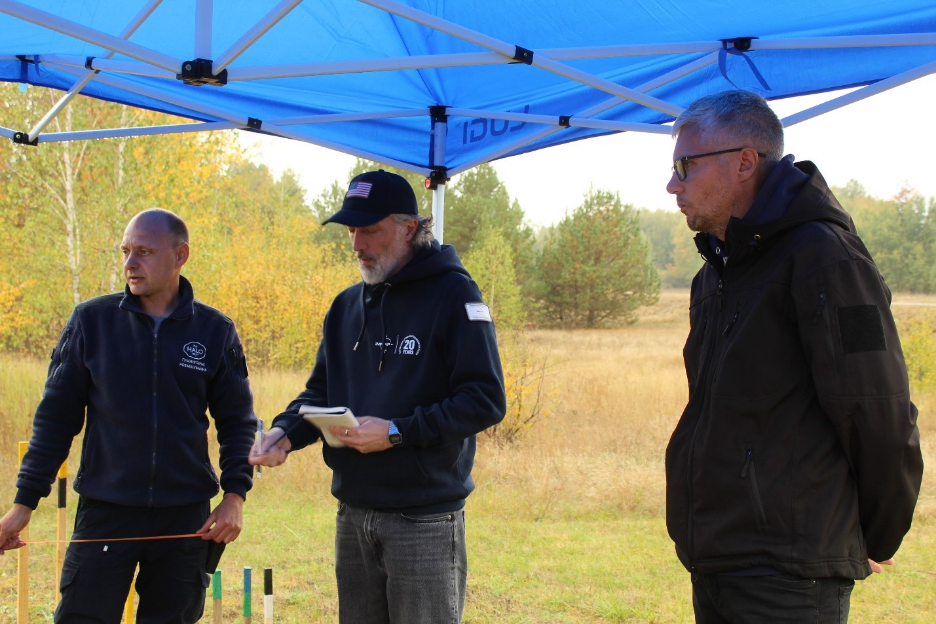
Photo 1. HALO’s Task Group Commander Oleksiy Kravchenko (left), iMMAP TPM Project Manager Levan Rapava (center), and HALO’s Sub-Unit Commander Dmytro Ragulia at a checkpoint. (© iMMAP)
A New Approach to Detection
We leave the checkpoint behind and walk out into the field. The deminers are already at work, moving methodically across the ground.
Nine people are deployed in two teams, Kravchenko explains. One searches the surface using handheld metal detectors. The other works with APEX, an advanced detection system introduced by the US-based company Minesight. Recently approved for use by The HALO Trust, the system is being tested in real field conditions to assess how it can improve the efficiency of clearance operations.
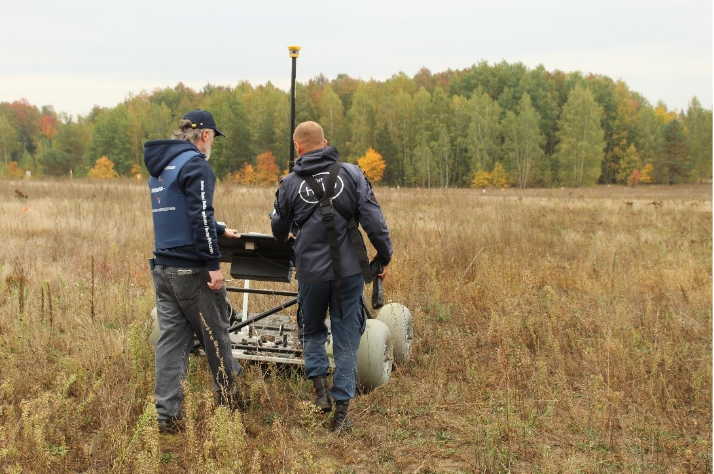
We watch as the Team Leader Oleksandr Morozov pushes a lightweight, four-wheeled frame across the field. Special coils and sensors scan the ground as the equipment moves, helping detect and locate potential hazardous metal objects while distinguishing them from much of the metallic debris scattered across the site.
A trained data analyst uses specialized software to review the signals and generate a map showing the locations of targets that require further investigation. This helps deminers avoid unnecessary digging, save time and focus their efforts on signals that warrant closer examination.
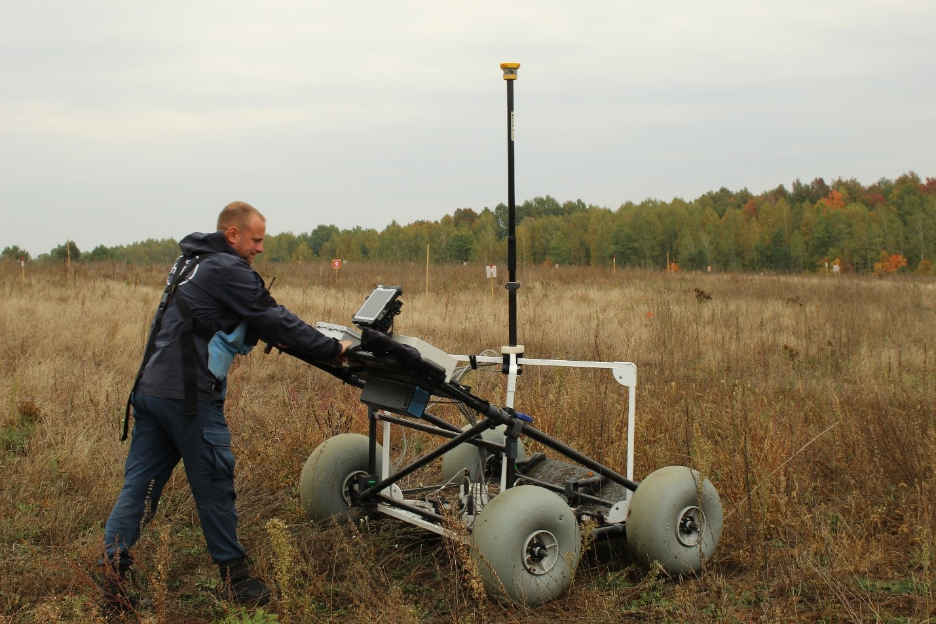
Photo 2. HALO’s Team Leader Oleksandr Morozov operates the APEX detection system at the site. (© iMMAP)
For the team on the ground, the difference is already measurable.
“We used APEX across four tasks and reviewed more than 6,000 signals but only had to excavate 136 of them. That means we were able to rule out around 98% of the signals without digging. That’s a fantastic result!” Ragulia says, clearly pleased.
These figures come from the team's experience in the field, where terrain and vegetation can affect performance. On flat, open ground like this, however, the technology offers a promising way to accelerate the work without abandoning the checks needed to keep clearance safe and thorough.
But the figures tell only part of the story. By observing the process firsthand, iMMAP’s TPM team can put reported results in context and see how APEX is being used in real working conditions. These observations complement the reported data and help build a clearer picture of the operational context in which new technologies are introduced.
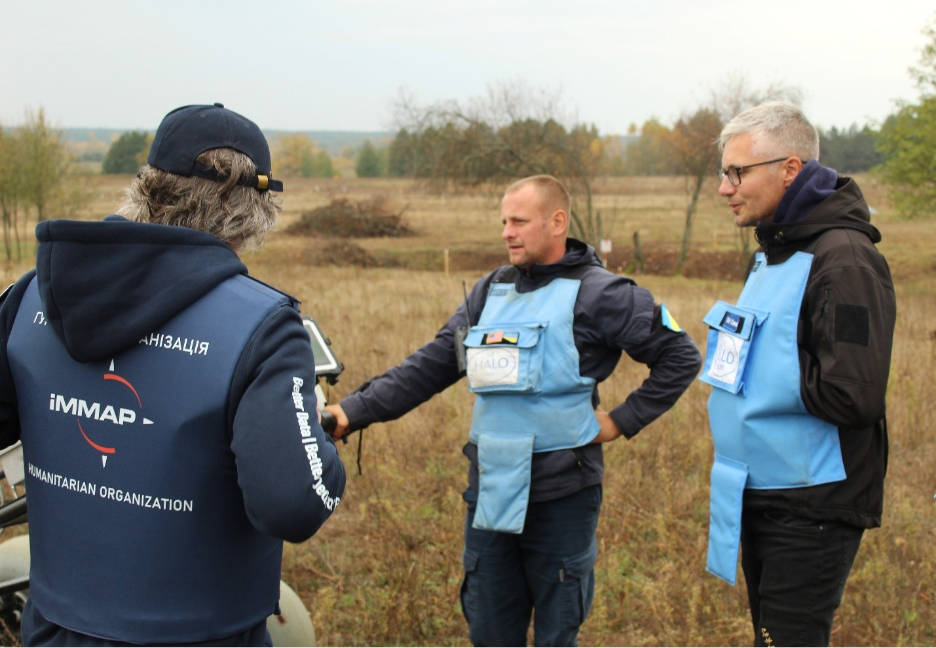
Photo 3. iMMAP’s Levan Rapava and the HALO team discuss technological innovations in the field. (© iMMAP)
Innovation That Makes a Difference
APEX is one of several technologies The HALO Trust is exploring to enhance its demining operations. HALO’s Dmytro Ragulia encourages his teams to test new equipment in the field and assess its performance in real working conditions.
“As a Sub-Unit Commander, I oversee 12 teams, and I try to introduce and test any new equipment that becomes available,” he says. “The more efficiently we work, the sooner the land can be returned to the people who need it and contribute to the country’s recovery.”
For iMMAP, independent monitoring is part of ensuring that new approaches are accompanied by evidence of how activities are carried out in practice. Field observations and feedback help implementing partners identify opportunities to improve their operations, while giving the donor an independent perspective on reported progress.
“Third-party monitoring is not just about the number of visits we conduct or reports we produce. Its value lies in how our findings help improve operations and support better-informed decisions,” says Levan Rapava, iMMAP’s TPM Project Manager. “When our implementing partners introduce new technologies such as APEX, we monitor how these approaches are used in practice, identify where improvements may be needed, and provide the donor with independent evidence of how activities are carried out and whether reported results are consistent with our field observations.”
HALO’s Dmytro Ragulia also sees value in the collaboration, noting that iMMAP’s monitoring gives the HALO Trust an opportunity to review its activities and identify practical ways to improve its work.
Bringing the Land Back to Life
Clearance work at the site in Ivankivska hromada is nearing completion.
Local farmers and residents of nearby villages are expected to benefit once the land has been cleared and released for use. iMMAP’s TPM team will return to verify the completed task and assess the results, helping establish whether the reported work is supported by field evidence.
For the people who depend on this land, the ultimate measure of progress will be the day they can use it safely again.
(© iMMAP)