
This spring, iMMAP Ukraine’s Third-Party Monitoring (TPM) team visited a remote training site in Ukraine to conduct an independent monitoring of an ongoing humanitarian demining training program.
The facility, operated by Tetra Tech under funding from the U.S. Department of State’s Bureau of Political-Military Affairs Office of Weapons Removal and Abatement (PM/WRA), trains Ukrainian deminers who are now deploying across the country to support humanitarian clearance operations. (For security reasons, the exact location of the training site cannot be disclosed). 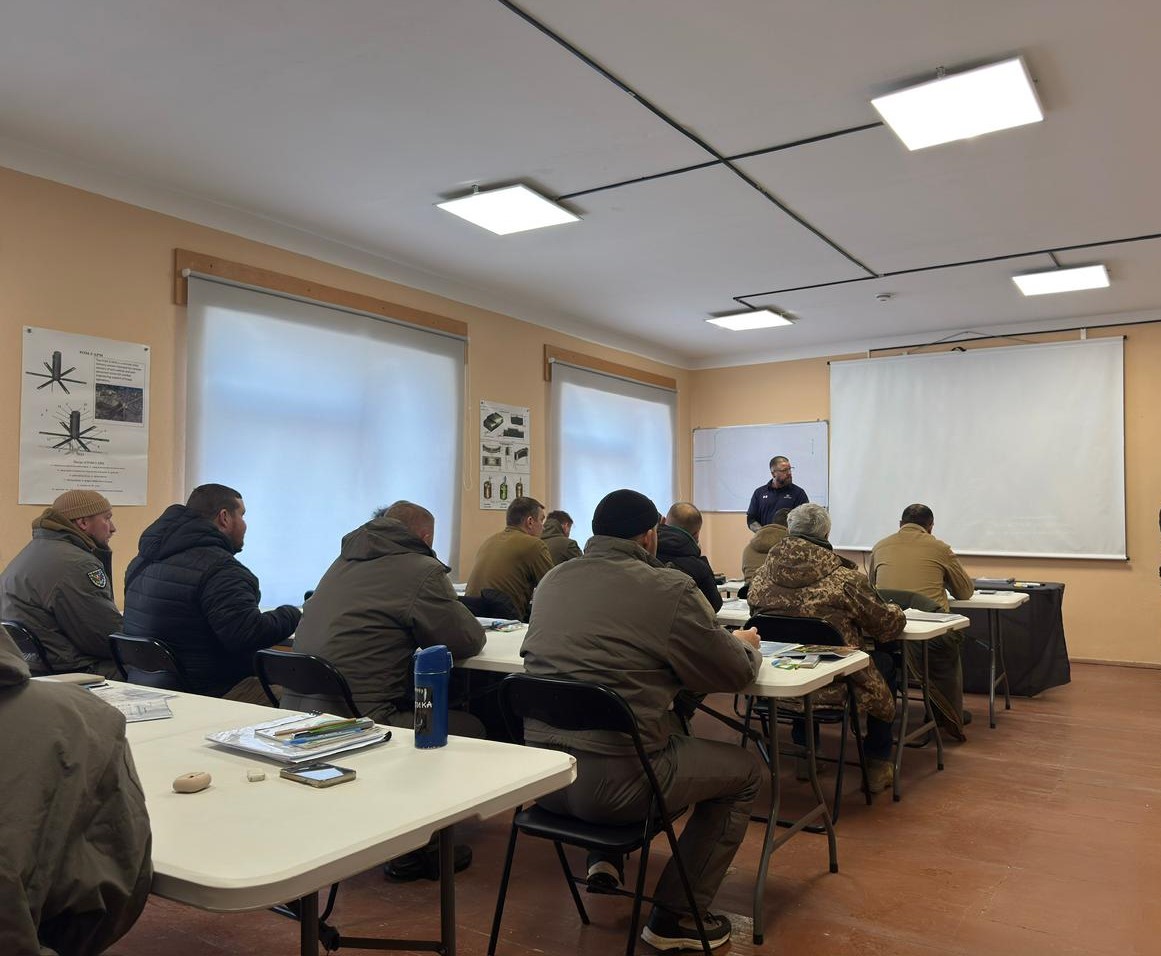
Photo: Trainees attend a classroom session at Tetra Tech’s training center.
Since the start of the full-scale invasion in 2022, Tetra Tech has become one of the key actors helping Ukraine rapidly expand its humanitarian demining efforts. Supported by the U.S. Department of State, the organization works closely with Ukrainian government institutions responsible for large-scale clearance operations. Today, many of the trainees at the center come from the State Special Transport Service (SSTS) under Ukraine’s Ministry of Defense.
Inside the training center, the atmosphere shifts between classroom instruction and field simulation. In one room, trainees study ordnance identification, explosive physics, and safety procedures. Outside, they move through practical exercises designed to mirror real operational conditions as closely as possible.
At the time of iMMAP’s visit, 14 SSTS personnel were completing an IMAS Explosive Ordnance Disposal (EOD) Level 1 course – an entry-level qualification that trains specialists to locate, expose, and dispose of specific explosive ordnance items in controlled conditions according to International Mine Action Standards (IMAS).
“We try to connect the classroom side with the hands-on work, so students can immediately apply what they’ve learned,” says, Tetra Tech’s Liaison Officer.
The practical side of the course takes place on a purpose-built training ground connected by marked safe lanes. According to Tetra Tech’s Deputy Team Leader, each part of the site introduces trainees to a different stage of field operations.
“We’ve got testing areas where students can work with different detectors, then areas where they need to operate in full PPE (personal protective equipment) before moving into the BAC (battle area clearance) and MMC (manual mine clearance) lanes,” DTL explains. “It’s all designed to get people comfortable operating in conditions much closer to the real thing.”
Many of the instructors are former military EOD specialists with operational experience, something trainees often point to as one of the program’s biggest strengths.
While iMMAP’s TPM team does not assess the technical quality of instruction itself, its role is to independently verify that activities funded under the project are taking place as planned and in line with agreed operational standards and safety requirements. During monitoring visits, TPM teams observe training activities, confirm participant attendance, collect required documentation for reporting, and gather feedback from trainees and implementing partners.
For Levan Rapava, iMMAP’s TPM Field Team Leader, those field observations offer an important picture of how humanitarian mine action support translates into operational capacity on the ground.
“The feedback from trainees has been very positive, and you can clearly see the level of professionalism here,” Rapava says. “Programs like this are helping Ukraine build the workforce it needs for long-term humanitarian demining.” 
Photo: Tetra Tech’s Liaison Officer (left) discusses the ongoing training with iMMAP TPM Field Team Leader Levan Rapava.
Since launching the program, Tetra Tech has trained more than 2,500 deminers, many of whom are now actively engaged in clearance operations across Ukraine. But with vast areas of agricultural land, civilian infrastructure, and communities still affected by contamination, the demand for trained specialists continues to grow.
Tetra Tech says it plans to further expand its training activities, potentially including more advanced programs in mechanical demining as Ukraine continues to scale up national mine action capacity.
“As a former military, I’ve always believed this: when there’s a need, that’s where we show up,” Tetra Tech Liaison Officer says. “And right now, Ukraine needs skilled deminers more than ever.”